On Time Fashions Flara Jackey for Prom
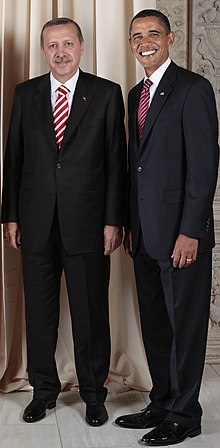

A suit, lounge suit, or business suit is a set up of clothes comprising a suit jacket and trousers of identical textiles worn with a collared wearing apparel shirt, necktie, and dress shoes. It is considered breezy wear in Western dress codes. The lounge suit originated in 19th-century Uk as a more coincidental alternative for sportswear and British country clothing. Later replacing the black apron glaze in the early on 20th century as regular daywear, a sober one-colored suit became known as a lounge adapt.
Suits are offered in different designs and constructions. Cut and cloth, whether ii- or three-slice, unmarried- or double-breasted, vary, in addition to various accessories. A two-piece arrange has a jacket and trousers; a 3-slice suit adds a waistcoat.[1] Hats were most ever worn outdoors (and sometimes indoors) with all men'southward clothes until the counterculture of the 1960s in Western culture. Informal suits have been traditionally worn with a fedora, a trilby, or a flat cap. Other accessories include handkerchief, suspenders or belt, watch, and jewelry.
Other notable types of suits are for semi-formal occasions—the dinner suit (blackness tie) and the blackness lounge suit (stroller)—both which arose as less formal alternatives for the formal wear of the wearing apparel coat for white necktie, and the morning coat with formal trousers for morning time dress, respectively.
Originally, suits were always tailor-fabricated from the client'southward selected material. These are now known every bit bespoke suits, custom-made to measurements, sense of taste, and fashion preferences. Since the 1960s, most suits are mass-produced prepare-to-wearable garments. Currently, suits are offered in roughly 4 ways:
- bespoke, in which the garment is custom-made by a tailor from a design created entirely from the customer'southward measurements, giving the best fit and gratis pick of material;
- made to measure, in which a pre-fabricated pattern is modified to fit the customer, and a limited selection of options and fabrics is available;
- ready-to-habiliment, off-the-peg (Commonwealth English), or off-the-rack (American English), which is sold every bit is, although some tailor alteration tends to be required;
- suit separates, where lounge jacket and trousers are sold separately in guild to minimize alterations needed, including besides odd-colored blazers or sports coats as smart coincidental options[2]
Terminology [edit]

The word suit derives from the French suite,[three] meaning "following," from some Late Latin derivative grade of the Latin verb sequor = "I follow," because the component garments (jacket and trousers and waistcoat) follow each other and take the aforementioned cloth and color and are worn together.
As a arrange (in this sense) covers all or most of the wearer'due south body, the term "suit" was extended to a single garment that covers all or virtually of the body, such equally boilersuits, diving suits, and spacesuits (come across Adjust (disambiguation)).
History [edit]
The current styles, founded in the Great Male person Renunciation of the belatedly 18th century, sharply changed the elaborately embroidered and jewelled formal clothing into the simpler clothing of the British Regency menses, which gradually evolved to the stark formality of the Victorian era. In the late 19th century, it was in the search for more comfort that the loosening of rules gave rise to the modern lounge suit.
Brooks Brothers is generally credited with start offering the "set-to-wear" suit,[ commendation needed ] a suit that was sold already manufactured and sized, prepare to be tailored, while Haggar Clothing first introduced the concept of conform separates in the U.S., which are widely found in the marketplace today.
Composition [edit]
There are many possible variations in the choice of the manner, the garments, and the details of a accommodate.
Cut [edit]

A man dressed in a iii-piece suit and bowler hat.
The silhouette of a suit is its outline. Tailored balance created from a canvas fitting allows a counterbalanced silhouette so a jacket demand not be buttoned and a garment is not too tight or too loose. A proper garment is shaped from the neck to the chest and shoulders to drape without wrinkles from tension. Shape is the essential part of tailoring that oft takes hand work from the get-go. The ii main cuts are double-breasted suits, a conservative pattern with two columns of buttons, spanned by a large overlap of the left and right sides; and single-breasted suits, in which the sides overlap very slightly, with a single column of buttons.
Proficient tailoring anywhere in the globe is characterised past strongly tapered sides and minimal shoulder, whereas rack suits are often padded to reduce labour. More casual suits are characterised by less structure and tailoring, much similar the sack adapt, a loose American style.[iv]
There are 3 ways to buy suits:
- Set up-fabricated and contradistinct "sizes" or precut patterns, a convenience that frequently is expressed over time with wrinkles from poor shaping, leading to distortion;
- The fabricated-to-measure adjust, in which a pre-existing pattern is contradistinct to reflect the individual'southward preference or nuances of physique to achieve things similar the style, lengths, shoulder slope and point-to-indicate and trouser fitting;
- The custom, bespoke, or tailoring-designed adapt, which has at least one basted fitting in which a one-half-made glaze (usually just scraps of textile basted together) is worn by the client in lodge to allow the tailor readjust the design several times before finishing the garment. This process tin can take the tailor hands fourscore hours.
The acid test of authentic tailoring standards is the wrinkle that comes from poor tailoring. Rumples tin can be pressed out. For acting fittings, "Rock Of Heart" (which ways trained freehand based on an experienced artistic eye to match the detail to the wearer, trusting the eye over unyielding scripted approach), cartoon and cut inaccuracies are overcome past the fitting.[5]
Fabric [edit]
Suits are made in a multifariousness of fabrics, but almost commonly from wool. The two master yarns produce worsteds (where the fibres are combed before spinning to produce a smooth, hard wearing material) and woollens (where they are not combed, thus remaining comparatively fluffy in texture). These can be woven in a number of ways, producing flannel, tweed, gabardine, and fresco among others. These fabrics all have different weights and feels, and some fabrics have an S (or Super Southward) number describing the fineness of the fibres measured by average fibre diameter, due east.g., Super 120; the effectively the cloth, the more fragile and thus less probable to be long-wearing information technology volition be. Although wool has traditionally been associated with warm, beefy wear meant for warding off cold weather, advances in making finer and finer fibre take made wool suits acceptable for warmer weather, equally fabrics have appropriately become lighter and more supple. Wool fabric is denominated by the weight of a ane-square yard piece; thus, the heavier wools, suitable for winter only, are 12–14 oz.; the medium, "three-season" (i.e., excluding summer) are ten–11 oz.; and summer wools are vii–viii oz.[ citation needed ] (In the days before primal heating, heavier wools such every bit 16 oz. were used in suits; now they are used mainly in overcoats and topcoats.) Other materials are used sometimes, either lone or blended with wool, such as cashmere.[six] Silk solitary or blended with wool is sometimes used. Constructed materials, east.g., polyester, while cheaper, are very rarely recommended by experts. At most, a blend of predominantly wool may be acceptable to obtain the chief benefit of synthetics, namely resistance to wrinkling, particularly in garments used for travel; however, any synthetic, blended or otherwise, will ever be warmer and clammier than wool lonely.[ citation needed ] For hot weather, linen is too used, and in the Southern U.s.a., cotton seersucker is worn.

The main 4 colours for suits worn in business organization are black, light greyness, dark gray, and navy, either with or without patterns. In particular, grey flannel suiting has been worn very widely since the 1930s. In non-business settings or less-formal business contexts, brownish is another important colour; olive likewise occurs. In summer, lighter shades such as tan or cream are popular.[seven] [8]

For not-business use, tweed has been popular since Victorian times and even so is usually worn. A wide range of colour is bachelor, including muted shades of green, brown, red, and grey.[ix] Tweeds are usually checked, or plain with a herringbone weave, and are nigh associated with the land. While full tweed suits are non worn by many now, the jackets are often worn equally sports jackets with odd trousers (trousers of different cloth).
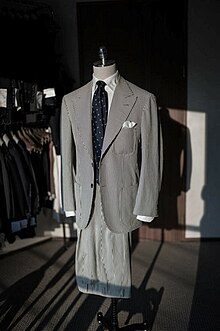
The nearly conventional conform has two or iii buttons and is either medium-to-dark greyness or navy. Other conservative colours are grey, black, and olive. White and light blues are acceptable at some events, particularly in the warm season. Cherry-red and the brighter greens are commonly considered "anarchistic" and "garish". Tradition calls for a gentleman'due south suit to exist of incomparably plain colour, with splashes of bright colour reserved for shirts, neckties or kerchiefs.
In the United States and the Britain, around the start of the 20th century, lounge suits were never traditionally worn in plain black, this colour instead being reserved for formal habiliment[ten] (including dinner jackets or strollers) and for undertakers. Notwithstanding, the pass up of formal habiliment since the 1950s and the rise of coincidental wear in 1960s immune the black adapt to return to fashion, every bit many designers began wanting to motion away from the business conform toward more than fashion suits.
Traditional business organisation suits are by and large in solid colours or with pinstripes;[11] windowpane checks are also adequate. Exterior business concern, the range of acceptable patterns widens, with plaids such equally the traditional glen plaid and herringbone, though apart from some very traditional environments such as London cyberbanking, these are worn for business now too. The colour of the patterned element (stripes, plaids, and checks) varies past gender and location. For example, assuming checks, specially with tweeds, have fallen out of utilize in the U.s., while they keep to exist worn every bit traditional in Great britain. Some unusual old patterns such as diamonds are at present rare everywhere.
Within the jacket of a suit, between the outer fabric and the inner lining, in that location is a layer of sturdy interfacing fabric to prevent the wool from stretching out of shape; this layer of cloth is called the sheet after the fabric from which it was traditionally fabricated. Expensive jackets have a floating canvas, while cheaply manufactured models have a fused (glued) canvas.[12] A fused canvas is less soft and, if poorly done, damages the suppleness and durability of the jacket,[13] and so many tailors are quick to deride fused canvas as beingness less durable, especially since they may tend to permanently pucker forth the jacket's edges subsequently some use or a few dry cleanings.[14] Nonetheless, some selling this type of jacket claim that the difference in quality is very small.[fifteen] A few London tailors state that all bespoke suits should apply a floating canvass.[16]
Jacket [edit]
Front buttons [edit]

Single- vs. double-breasted jacket
Nigh single-breasted suits have two or three buttons, and 4 or more than buttons are unusual. Dinner jackets ("blackness necktie") usually take only one push. It is rare to detect a adapt with more than four buttons, although zoot suits can have as many as six or more than due to their longer length. There is besides variation in the placement and manner of buttons,[17] since the push placement is critical to the overall impression of height conveyed by the jacket. The centre or top button will typically line up quite closely with the natural waistline.[18] The lesser button is usually non meant to be buttoned so the jacket is cut such that buttoning the lesser push would ruin the lines and drape of the jacket. It is customary to keep the jacket buttoned while standing and to unbutton the jacket while seated.
Double-breasted jackets have only half their outer buttons functional, equally the second row is for display only, forcing them to come in pairs. Some rare jackets can have as few as ii buttons, and during various periods, for instance the 1960s and 70s, equally many equally eight were seen. 6 buttons are typical, with ii to button; the last pair floats above the overlap. The 3 buttons down each side may in this case be in a direct line (the 'keystone' layout) or more than unremarkably, the top pair is half as far apart again every bit each pair in the bottom foursquare. A four-button double-breasted jacket usually buttons in a square.[xix] The layout of the buttons and the shape of the lapel are co-ordinated in gild to direct the optics of an observer. For example, if the buttons are besides low, or the lapel gyre too pronounced, the eyes are drawn down from the face up, and the waist appears larger.[20] There seems to be no clear rule equally to on which side the overlap should prevarication. It usually crosses naturally with the left side to the fore but not invariably. Generally, a subconscious button holds the underlap in place.
Lapels [edit]

Notched lapel

Peaked lapel

Shawl lapel

Comparison of two notched lapel cuts: English (left) and Castilian (right). The quondam is the most commonly seen notched lapel[21]
The jacket's lapels can be notched (too called "stepped"), peaked ("pointed"), shawl, or "fox" (Mandarin and other anarchistic styles). Each lapel style carries different connotations and is worn with different cuts of adapt. Notched lapels, the well-nigh common of the three, are normally only establish on single-breasted jackets and are the nearly informal manner. They are distinguished by a 75-to-90 caste "notch" at the point where the lapel meets the neckband.[22] Peaked lapels have precipitous edges that point upward towards the shoulders. Double-breasted jackets usually have peaked lapels, although peaked lapels are sometimes found on single breasted jackets as well. Shawl lapels are a manner derived from the Victorian informal evening habiliment, and every bit such are not normally seen on suit jackets except for tuxedos or dinner suits.[23] For blackness tie events, but jackets with pointed and shawl lapels should be worn.[24]
In the 1980s, double-breasted suits with notched lapels were pop with power suits and the New Moving ridge mode.[ citation needed ]
In the late 1920s and 1930s, a pattern considered very stylish was the unmarried-breasted peaked-lapel jacket. This has gone in and out of faddy periodically, being popular again during the 1970s,[ citation needed ] and is still a recognised alternative. The power to properly cut peaked lapels on a single-breasted adjust is one of the most challenging tailoring tasks, even for very experienced tailors.[25]
The width of the lapel is a varying aspect of suits and has changed over the years. The 1930s and 1970s featured exceptionally wide lapels, whereas during the late 1950s and most of the 1960s suits with very narrow lapels—often only about 1 inch (2.5 cm) wide—were in fashion. The 1980s saw mid-size lapels with a low gorge (the point on the jacket that forms the "notch" or "peak" betwixt the collar and front end lapel). Current (mid-2000s) trends are towards a narrower lapel and college gorge.[ citation needed ] Tie width commonly follows the width of the jacket lapel.
Lapels besides have a buttonhole, intended to agree a boutonnière, a decorative flower. These are now but normally seen at more formal events. Ordinarily, double-breasted suits have 1 hole on each lapel (with a blossom just on the left), while single-breasted suits have just i on the left.[26]
Pockets [edit]
Most jackets have a variety of inner pockets and two chief outer pockets, which are generally either patch pockets, flap pockets, or jetted ("besom") pockets.[27] The patch pocket is, with its single extra piece of cloth sewn directly onto the front end of the jacket, a sporting option, sometimes seen on summertime linen suits or other informal styles. The flap pocket is standard for side pockets, and has an extra lined flap of matching fabric covering the meridian of the pocket. A jetted pocket is about formal, with a small strip of fabric taping the summit and lesser of the slit for the pocket. This style is most ofttimes on seen on formalwear, such as a dinner jacket.
A breast pocket is usually found at the left side, where a pocket square or handkerchief can be displayed.
In add-on to the standard two outer pockets and breast pocket, some suits have a fourth, the ticket pocket, usually located simply above the correct pocket and roughly half as wide. While this was originally exclusively a characteristic of country suits, used for conveniently storing a train ticket, information technology is at present seen on some town suits. Another country feature besides worn sometimes in cities is a pair of hacking pockets, which are similar to normal ones, but slanted; this was originally designed to make the pockets easier to open on horseback while hacking.[4]
Sleeves [edit]
Suit jackets in all styles typically have three or four buttons on each cuff, which are often purely decorative (the sleeve is commonly sewn closed and cannot be unbuttoned to open up). Five buttons are unusual and are a mod mode innovation. The number of buttons is primarily a function of the formality of the accommodate; a very casual summer sports jacket might traditionally (1930s) have had but ane push button, while tweed suits typically have three and urban center suits four. In the 1970s, two buttons were seen on some city suits.[ commendation needed ] Today, four buttons are common on nigh business suits and fifty-fifty casual suits.
Although the sleeve buttons unremarkably cannot exist undone, the stitching is such that it appears they could. Functional cuff buttons may be plant on high-end or bespoke suits; this characteristic is called a surgeon's gage and "working button holes" (U.S.).[28] Some wearers get out these buttons undone to reveal that they can afford a bespoke suit, although it is proper to leave these buttons done up.[29] Modern bespoke styles and high-end off-the-rack suits equipped with surgeon'southward cuffs have the last 2 buttons stitched off-centre, so that the sleeve hangs more cleanly should the buttons ever exist undone. Certainty in fitting sleeve length must be achieved, as once working button holes are cut, the sleeve length essentially cannot be altered further.
A cuffed sleeve has an extra length of fabric folded back over the arm, or just some piping or stitching above the buttons to insinuate to the edge of a gage. This was popular in the Edwardian era, equally a feature of formalwear such as apron coats carried over to informalwear, but is now rare.
Vents [edit]
A vent is a slit in the bottom rear (the "tail") of the jacket. Originally, vents were a sporting option, designed to make riding easier, so are traditional on hacking jackets, formal coats such every bit a morning glaze, and, for practicality, overcoats. Today at that place are three styles of venting: the unmarried-vented mode (with one vent at the centre), the ventless fashion, and the double-vented style (one vent on each side). Vents are user-friendly, particularly when using a pocket or sitting down, to amend the hang of the jacket,[30] so are now used on most jackets. Ventless jackets are associated with Italian tailoring, while the double-vented style is typically British.[4] Dinner jackets traditionally have no vents.
Waistcoats [edit]
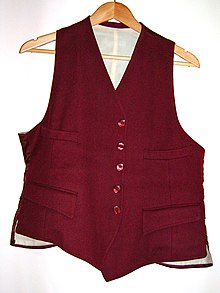
A traditional waistcoat, to be worn with a ii-piece adjust or split jacket and trousers.
Waistcoats (called vests in American English) were almost e'er worn with suits prior to the 1940s. Due to rationing during World State of war Ii, their prevalence declined, but their popularity has gone in and out of mode from the 1970s onwards. A pocket spotter on a chain, one finish of which is inserted through a middle buttonhole, is oft worn with a waistcoat; otherwise, since World State of war I, when they came to prominence of military necessity, men have worn wristwatches, which may be worn with any adapt except the full evening dress (white tie). Although many examples of waistcoats worn with a double-breasted jacket tin can exist plant from the 1920s to the 1940s, that would be unusual today (i point of a double-breasted jacket beingness, it may exist supposed, to eliminate the waistcoat). Traditionally, the bottom button of a waistcoat is left undone; like the vents in the rear of a jacket, this helps the body bend when sitting. Some waistcoats tin can have lapels; others practise not.
Trousers [edit]
Suit trousers are ever fabricated of the same cloth equally the jacket. Even from the 1910s to 1920s, before the invention of sports jackets specifically to exist worn with odd trousers, wearing a suit jacket with odd trousers was seen as an alternative to a full suit.[31] However, with the mod appearance of sports jackets, adapt jackets are always worn with matching trousers, and the trousers are worn with no jacket or the advisable jacket.[ citation needed ]
Trouser width has varied considerably throughout the decades. In the 1920s, trousers were straight-legged and wide-legged, with a standard width at the cuff of 23 inches (58 cm). After 1935, trousers began to be tapered in at the lesser half of the leg. Trousers remained broad at the pinnacle of the leg throughout the 1940s. Past the 1950s and 1960s, a more slim look had become popular. In the 1970s, arrange makers offered a variety of styles of trousers, including flared, bell bottomed, broad-legged, and more traditional tapered trousers. In the 1980s, these styles disappeared in favor of tapered, slim-legged trousers.
One variation in the design of trousers is the use or not of pleats. The most classic manner of trouser is to have two pleats, ordinarily forward, since this gives more condolement sitting and better hang standing.[32] This is still a common fashion, and for these reasons of utility has been worn throughout the 20th century. The fashion originally descended from the exaggeratedly widened Oxford numberless worn in the 1930s in Oxford, which, though themselves short-lived, began a trend for fuller fronts.[33] The mode is still seen as the smartest, featuring on wearing apparel trousers with black and white necktie. Even so, at various periods throughout the last century, flat-fronted trousers with no pleats have been worn, and the swing in fashions has been marked enough that the more manner-oriented set up-to-wear brands have non produced both types continuously.
Turn-ups on the lesser of trousers, or cuffs, were initially popularised in the 1890s by Edward VII,[34] and were popular with suits throughout the 1920s and 1930s. They have always been an informal option, beingness inappropriate on all formalwear.
Other variations in trouser style include the rise of the trouser. This was very high in the early on one-half of the 20th century, peculiarly with formalwear, with rises above the natural waist,[35] to allow the waistcoat roofing the waistband to come up down but below the narrowest point of the chest. Though serving less purpose, this high height was duplicated in the daywear of the period. Since and so, fashions take changed, and take rarely been that high again, with styles returning more to low-rise trousers, even dropping downwards to have waistbands resting on the hips. Other irresolute aspects of the cut include the length, which determines the break, the bunching of cloth merely higher up the shoe when the forepart seam is marginally longer than height to the shoe's peak. Some parts of the world, such every bit Europe, traditionally opt for shorter trousers with little or no break, while Americans often cull to wear a slight break.[36]
A last major stardom is made in whether the trousers accept a belt or braces (suspenders). While a chugalug was originally never worn with a accommodate, the forced wearing of belts during wartime years (caused by restrictions on utilise of elastic caused by wartime shortages) contributed to their rise in popularity, with braces now much less popular than belts. When braces were mutual, the buttons for attaching them were placed on the outside of the waistband, considering they would be covered past a waistcoat or cardigan, just now it is more frequent to button on the inside of the trouser. Trousers taking braces are rather dissimilar in cut at the waist, employing actress girth and also height at the back. The split in the waistband at the dorsum is in the fishtail shape. Those who prefer braces assert that, considering they hang from the shoulders, they always make the trousers fit and hang exactly as they should, while a belt may allow the trouser waist to slip down on the hips or below a protruding midsection, and requires constant repositioning; as well, they allow, indeed work best with, a slightly looser waist which gives room for natural expansion when seated.
Arrange trousers, besides known as wearing apparel pants in the Us, are a mode of trousers intended as formal, semi-formal, or breezy wear. They are often made of either wool or polyester[37] (although many other synthetic and natural textiles are used) and may be designed to be worn with a matching adapt jacket. Suit trousers often have a crease in the front of each pant leg, and may accept ane or more than pleats. Suit trousers can be worn at many formal and semi-formal occasions combined with a shirt that has no tie and a more relaxed fashion, which can be considered smart casual wearing apparel.
Breeches [edit]
As an culling to trousers, breeches (or knickers in variations of English language where this does not refer to underwear) may be worn with informal suits, such every bit tweed. These are shorter, descending to just below the knees, fastened closely at the top of the dogie by a tab or push gage. While once common, they are now typically only worn when engaged in traditional outdoor sports, such as shooting or golf game. The length and design is closely related to the plus-fours (and plus-sixes etc.) worn for sport, but differ in having no appendage. They are usually designed to be worn with long socks meeting just below the knee, but riding breeches, worn with long boots such equally top boots, are long plenty to run across the boot and display no sock.[38]
Accessories [edit]
Accessories for suits include neckties, shoes, wristwatches and pocket watches, pocket squares, cufflinks, tie clips, tie tacks, necktie confined, bow ties, lapel pins, and hats.
Etiquette [edit]
Buttoning the arrange jacket [edit]


The bottom button of a single-breasted suit glaze is left unfastened.
The buttoning of the jacket is primarily adamant by the button stance, a mensurate of how high the buttons are in relation to the natural waist. In some (at present unusual) styles where the buttons are placed high, the tailor would have intended the suit to be buttoned differently from the more common lower stance. Nevertheless, some general guidelines are given here.
Double-breasted suit coats are near always kept buttoned. When in that location is more than one functional buttonhole (as in a traditional six-on-2 arrangement), only one button need exist fastened; the wearer may elect to spike but the bottom button, in order to nowadays a longer line (a manner popularised by Prince George, Duke of Kent).
Single-breasted suit coats may be either fastened or unfastened. In two-button suits the bottom button is traditionally left unfastened except with certain unusual cuts of jacket, due east.g. the paddock. Legend has it that Rex Edward 7 started the trend of leaving the bottom button of a accommodate as well as waistcoat undone.[39]
When fastening a 3-button suit, the middle button is attached, and the top one sometimes, just the bottom is traditionally not designed to be. Although in the past some three-push button jackets were cut so that all iii could exist fastened without distorting the drape, this is no longer the case. A iv-button suit is nontraditional and uncommon. The one-push suit has regained some popularity (it is also i of the classic styles of Savile Row tailoring). With a single-breasted suit, the buttons are usually unfastened while sitting downward to avoid an ugly drape. A double-breasted suit is often able to be left buttoned, to avert the difficulty of constantly redoing the inner button (the "ballast button") when standing upwards.
Shirts with suits [edit]
Socks with suits [edit]
In the U.s. it is common for socks to match either the shoe (particularly blackness socks with black shoes) or the trouser leg.[twoscore] This latter is preferred as information technology makes the leg announced longer, provides a smoother visual transition between the pant leg and the shoe, and minimises the attention drawn by a trouser leg tailored to exist too short. A more full general rule is for socks to be darker than the shade of the trousers, just potentially a different, instead matching some other function of the outfit such as the shirt or necktie. With patterned socks, ideally the background color of the sock should friction match the primary colour of the suit and the other colors should coordinate with other parts of the outfit.
Socks are preferably[ citation needed ] at least mid-calf summit, if not knee-height (over-the-calf), and are ordinarily made predominantly of cotton or wool, though luxury or dress socks may utilize more exotic blends such as silk and cashmere. Before World State of war Ii, patterned socks were common, and a variety of designs like Argyle or contrasting socks was commonly seen. After WWII, socks became more subdued in colour. In lieu of over-the-calf length (which will stay upward past itself), some men still utilise garters to hold up their socks, simply this is unusual.
Women [edit]

Accommodate-wearing etiquette for women generally follows the same guidelines used by men, with a few differences and more than flexibility.
For women, the brim suit or dress suit are both acceptable; a blouse, which can be white or coloured, ordinarily takes the place of a shirt. Women's suits tin also be worn with coloured tops or T-shirts. Besides, women usually wear suits in professional settings, rather than as general formal attire, as men do.
Women's suits come in a larger diversity of colours, such as darks, pastels, and gem colours.
Women by and large do not wear neckties with their suits, simply some do. Fancy silk scarves that resemble a floppy ascot necktie became popular in N America in the 1970s. By the 1980s, women were entering the white-collar workforce in increasing numbers, and their dress fashions adopted looks not dissimilar from men'southward concern wear. By the early on to mid-1980s, conservatively tailored brim suits were the norm, in the same colours and fabrics considered standard in men's suits. These were typically worn with buttoned-up collared blouses, unremarkably white or some pastel in colour. These were often accessorised with a version of the bow tie, usually the same fabrics, colours, and patterns every bit men's neckties and bow ties, but tied in a fuller bow at the collar. Pantyhose are worn with the brim adapt in black, nude or white.
Way [edit]
Western world [edit]
Throughout the 20th and 21st centuries, the tailors of England, Italy, Kingdom of spain, and France take been the leaders in the design of men'south suits.[41] The slim-fitting mohair and sharkskin suits developed in London and Milan during the 1960s were widely imitated by the mod subculture, and underwent a big scale revival during the late 2000s to mid 2010s due to their clan with James Bond and Don Draper from Mad Men.[42]
Due to the humid climate, Italian suits are frequently made in shades of light grey, sand or stone to reflect the sunlight. Typical fabrics include lightweight flannel, a wool and mohair blend, and linen or chino cloth for hot weather.[43]
Elsewhere in the Mediterranean, suits are considered impractical without constant air conditioning. As a result, well-nigh not-conservative businesses, regardless of size or wealth, tend to use casual clothes even in formal meetings.[44] Some professions, such as banking, law, and certain authorities employees that deal directly with the public do have a more formal dress lawmaking.
Some Israeli branches of American firms tend to imitate their American counterparts' style of business casual, smart coincidental and informal clothing. However, many conservative Israeli professionals, especially Hasidic Jews, continue to habiliment the traditional single-breasted black, navy blueish or grey rekel.
Usa [edit]


Rock musician Nick Cavern wears a pinstripe arrange while performing onstage.
Because wearing a suit conveys a respectable image, many people wear suits during the task interview process.[45] An interview suit is usually a conservative way, and frequently made of bluish or grey fabric. Interview suits are oft composed of wool or wool-blend fabric, with a solid or pin stripe pattern.[46] The style of an interview adapt, all the same, will depend on the organizational civilisation of the industry in which a person seeks employment.
In the Southwestern U.s., men'southward suits often feature detailing inspired by traditional Western wear, such as a pointed yoke and arrow pockets.[47] Suit coats similar in advent to the Ike jacket are also widespread, and it is common practise to vesture cowboy boots instead of conventional wearing apparel shoes. Country music singers and modern pop stars similar Mail service Malone[48] or Brandon Flowers of The Killers sometimes wear flashy Nudie suits with rhinestones and intricate embroidery.[49]
In modern society, men'due south suits accept become less common as an outfit of daily habiliment. During the 1990s, driven in part past the meteoric ascent of newly successful applied science companies with different cultural attitudes, the prevailing management philosophy of the fourth dimension moved in favour of more coincidental attire for employees; the aim was to encourage a sense of openness and egalitarianism. "Business casual" dress still tends to be the norm for near workers upwards to and sometimes including mid-level management. Traditional concern dress as an everyday way has been prevalent in middle- and upper-level corporate management (now sometimes collectively referred to every bit "suits"),[50] and the professions (particularly police force). Over fourth dimension, suits have go less common at the executive level aside for job candidates and formal events, remaining in widespread use at other lives such as among center-class hotel clerks and salespeople.[51] Casual dress has too become common in Western academic institutions, with traditional business concern attire falling in popularity.
For many men who practice not wear suits for piece of work, particularly in Western social club, wearing a suit is reserved for special occasions, such as weddings, funerals, court appearances, and other more than formal social events. Hence, because they are not a daily outfit for most men, they are oft viewed every bit being "stuffy" and uncomfortable. The combination of a tie, belt and belong tin can be tight and restrictive compared to contemporary casual habiliment, particularly when these are purchased at minimal cost and quality for rare occasions, rather than being made to be worn comfortably. This tendency became prevalent enough that the Christian Science Monitor reported that a adjust combined with a necktie and slacks was "a blueprint that guarantees that its wearer will be uncomfortable." [52] During the late 1960s and early 1970s, men's suits became less unremarkably worn, in much the same way that skirts and dresses were dropped by many women in favour of trousers. This was seen as a liberation from the conformity of earlier periods and occurred concurrently with the women's liberation movement.
Also remarkable is that the conform now often appears in Rock, Heavy Metal and Gothic happenings, even though such groups were once known for a rather rebellious tradition of habiliment. Artists and bands such equally Nick Cave, Interpol, Marilyn Manson, Blutengel and Akercocke are known for the use of formal clothing in music videos and stage performances. The conform also appears when fans apparel for styles such as Lolita, Victorian and Corporate Gothic.
Eastward and South asia [edit]
In 20th-century China, the Communist regime encouraged citizens to vesture the Mao suit due to its egalitarian and utilitarian design.[53]
After the independence of India, there was a backlash confronting Western fashions due to their clan with the previous colonialist regime. Instead, professional Indian men began wearing the five-button Nehru adjust, fabricated from khadi to support the local textile industry.[54] During the 1960s, these suits became stylish among the British modern subculture due to their utilise by The Beatles.[55] These made a brief comeback during the mid 2000s, only since 2010 they have been out of way in the West.[56]
In the tropical Philippines, a former colony of the Us, a accommodate is called terno; the jacket that comes with it is chosen amerikana. Because of the hot tropical climate, this formal vesture is worn but when necessary, including formal, social or business events. Filipinos rarely wear a suit, and the youth would probably wear one only to a high school or college prom, in which case it might exist rented.[ citation needed ] At whatever occasion where a adapt is worn, it would also be acceptable to habiliment a long-sleeved or a short-sleeved barong tagalog, the national wearing apparel of the Philippines.
Come across also [edit]
- Western dress codes
- Semi-formal wear
- Black tie
- Black lounge suit
- Informal wear
- Semi-formal wear
- Casual
- Smart casual
- Business organization casual
References [edit]
- ^ Flusser (2002). p. 146
- ^ Antongiavanni (2006). p. 35
- ^ Oxford English Dictionary Online (2008). suit, n. 19b.
- ^ a b c Flusser (1985). ch. 2
- ^ Mahon, Thomas (2005-09-23). "How to draft a pattern". English Cut. Archived from the original on 2008-07-25. Retrieved 2008-09-20 .
- ^ Antongiavanni (2006). p. 76
- ^ Flusser (2002). pp. 93–99
- ^ Antongiavanni (2006). pp. 80–86
- ^ Flusser (2002). p. 95
- ^ Antongiavanni (2006). p. 81
- ^ Flusser (2002). p. 94
- ^ Flusser (2002). p. 288
- ^ Antongiavanni (2006). p. 66
- ^ Mahon, Thomas (2005-02-08). "Fused vs. floating". English language Cut. Archived from the original on 2008-10-16. Retrieved 2008-09-twenty .
- ^ Merrion, Desmond (2008-11-08). "Contempo made to measure out tailoring". Archived from the original on 2009-02-03. Retrieved 2008-11-xix .
- ^ Mahon, Thomas (2005-01-06). "How to selection a "bespoke" tailor". English Cut. Archived from the original on 2008-10-29. Retrieved 2008-09-20 .
- ^ Druesdow (1990). p. half-dozen. "...for often the difference in style from season to flavor was in the distance between buttons..."
- ^ Flusser (2002). p. 83
- ^ Antongiavanni (2006). p. 14
- ^ Antongiavanni (2006). p. sixteen
- ^ García-Bragado, David (17 March 2014). Vestirse Por Los Pies: Los Secretos de Estilo del Auténtico Caballero. Hércules Edición. p. 181. ISBN978-eight-4927-1579-iv.
- ^ "What'due south the Difference Between a Notch Lapel, Peak Lapel, and Shawl Lapel on a Adjust". sharpsense.ca. Archived from the original on 2017-09-26. Retrieved 2017-09-26 .
- ^ Flusser (2002). pp. 82–85
- ^ "etiquette – SIMON PAUL". wordsbysimonpaul.wordpress.com.
- ^ Mahon, Thomas (2005-03-29). "Unmarried-breasted, peaked lapel". English Cutting. Archived from the original on 2009-01-04. Retrieved 2008-09-20 .
- ^ Boehlke, Volition (2007-01-07). "What's in your lapel?". A Suitable Wardrobe. Archived from the original on 2008-ten-14. Retrieved 2008-09-24 .
- ^ The Nu-Way Course in Fashionable Clothes Making (1926). Lesson 33
- ^ Mahon, Thomas (2007-01-18). "Real cuff holes..." English language Cut. Archived from the original on 2008-12-03. Retrieved 2008-ten-26 .
- ^ Rosenbloom, Stephanie (February xiii, 2009). "For Fine Recession Clothing, $7,000 Suits From Saks (Off the Rack)". The New York Times . Retrieved 2009-02-14 .
- ^ Antongiavanni (2006). p. 172
- ^ Flusser (2002). p. 100
- ^ Flusser (2002). p. 92
- ^ Flusser (2002). p. 112
- ^ Flusser (2002). p. 284
- ^ Croonborg (1907). p. 100 lists tables of trousers heights
- ^ Flusser (2002). p. 61
- ^ "Dress pants cloth data". Overstock.com. Retrieved 2010-03-12 .
- ^ Croonborg (1907). p. 118
- ^ Matthew, H. C. Grand. (September 2004; online edition May 2006) "Edward 7 (1841–1910)", Oxford Dictionary of National Biography, Oxford Academy Printing, doi:10.1093/ref:odnb/32975. Retrieved 24 June 2009 (Subscription required)
- ^ Flusser (2002). p. 173
- ^ "Difference Betwixt British, Italian & American Suits – Unlike Suit Styles & Cuts For Men". two June 2016.
- ^ Cochrane, Lauren (xv April 2014). "How Mad Men inverse the way men dress". The Guardian. London.
- ^ Mr. Mansel Fletcher (17 June 2015). "How to Dress Similar an Italian". Mr. Porter: A Gentleman'southward Guide. The Journal.
- ^ Elan, Priya (8 October 2016). "Italian brand that dressed 007 is latest victim of shift to coincidental office wear". The Guardian. London.
- ^ Wilson, Eric (2008-11-xiii). "The Return of the Interview Suit". The New York Times. pp. E1, E10. Retrieved 2008-eleven-22 .
- ^ Canisius College MBA Program (2008-04-24). "Dislocated well-nigh Ownership an Interview Suit...This is all you will always demand to know!". Archived from the original on 2008-12-23. Retrieved 2008-11-22 .
- ^ Stavropoulos, Laura (2019-05-12). "Nudie Cohn, Tailor And Legend Backside The Nudie Suit, Remembered By His Granddaughter Jamie". uDiscoverMusic . Retrieved 2019-06-08 .
- ^ Peacock, Tim (2019-01-17). "Post Malone, Kacey Musgraves Amidst The Stars Performing At The Grammy Awards". uDiscoverMusic . Retrieved 2019-06-08 .
- ^ "Rhinestone Cowboys: The Embroidered Suits Once Rocked By Johnny Cash and Gram Parsons Are Making a High-Style Comeback". Billboard . Retrieved 2019-06-08 .
- ^ Curtailed Oxford English Dictionary 10th ed. Oxford Academy Press. 2002. p. 1433 "informal a loftier–ranking concern executive".
- ^ Dent, Mark (2019-09-30). "How the power adjust lost its power". vocalisation.com . Retrieved 2019-10-03 .
- ^ To save power, Bangladesh bans suits and ties, The Christian Science Monitor, September 5, 2009
- ^ Montefiore, Clarissa Sebag. "From Red Guards to Bail villains: Why the Mao suit endures".
- ^ "The Nehru Jacket Guide — Gentleman's Gazette". gentlemansgazette.com.
- ^ "John Lennon'southward iconic conform goes on auction after being lost for twoscore years". 29 Oct 2015.
- ^ "Cultural Imperialist – Neh-ruing the Day: No to Nehru". Cultural Imperialist.
Sources [edit]
- Antongiavanni, Nicholas (2006). The Suit: A Machiavellian Approach to Men's Fashion. HarperCollins. ISBN978-0-06-089186-2.
- Boyer, Bruce (1990). Eminently Suitable: The Elements of Style In Business Attire. The Haddon Craftsmen. ISBN0-393-02877-1.
- Boyer, G. Bruce (September 1990). Eminently Suitable: The Elements of Mode in Business organisation Attire. Tony Kokinos (illustrator). W. West. Norton & Company. ISBN978-0-393-02877-5.
- Calasibetta, Charlotte Mankey (2003). The Fairchild Lexicon of Manner. Fairchild Publications. ISBN1-56367-235-ix.
- Croonborg, Frederick (1907). The Blue Book of Men'due south Tailoring. New York and Chicago: Croonborg Sartorial Co.
- Druesedow, Jean 50.; Jno. J. Mitchell Co (1990). Men's Fashion Illustrations from the Turn of the Century: by Jno. J. Mitchell Co. Courier Dover Publications. ISBN978-0-486-26353-3.
- Flusser, Alan (1985). Wearing apparel and the Homo: The Principles of Fine Men'south Apparel. Villard. ISBN0-394-54623-seven . Retrieved 2008-09-20 .
- Flusser, Alan (2002). Dressing the Man: Mastering the Art of Permanent Fashion. HarperCollins. ISBN0-06-019144-9.
- Flusser, Alan (1996). Mode and the Human . HarperCollins. ISBN0-06-270155-10.
- Keers, Paul (October 1987). A Gentleman'south Wardrobe: Classic Wearing apparel and the Modern Man. Weidenfeld & Nicolson. ISBN978-0-297-79191-1.
- Kidwill, Claudia, B. (1974). Suiting Everyone: The Democratization of Clothing in America. Smithsonian Institution Press.
- The New-Style Course in Stylish Dress-Making. Fashion Institute. 1926. OCLC 55530806. Archived from the original on 2008-07-05. Retrieved 2008-08-20 .
External links [edit]
 | Wikimedia Commons has media related to Suits. |
- Emily Post's Etiquette: The Clothes of a Gentleman, 1922
- "Introduction to 18th-century manner". Mode, Jewellery & Accessories. Victoria and Albert Museum. Retrieved 2008-08-06 .
- Meek, Miki; Lam Thuy Vo (September 6, 2012). "The Difference Between A $99 Suit And A $5,000 Suit, In One Graphic". Planet Money. Retrieved Oct 10, 2013.
0 Response to "On Time Fashions Flara Jackey for Prom"
Post a Comment