Pretty Beach Backgrounds Old Fashioned Diners

Counter service at a pocket-sized diner in Brooklyn


A diner is a small, inexpensive restaurant constitute all over the United States, as well every bit in Canada and parts of Western Europe. Diners offering a wide range of foods, by and large American cuisine, a coincidental temper, and, characteristically, a combination of booths served by a waitstaff and a long sit-down counter with direct service, in the smallest merely by a cook. Many diners accept extended hours, and some along highways and areas with meaning shift piece of work stay open up for 24 hours.
Considered quintessentially American,[ii] many diners share an archetypal exterior form. Some of the earliest were converted rail cars, retaining their streamlined structure and interior fittings. From the 1920s to the 1940s, diners, by then commonly known as "lunch cars", were usually prefabricated in factories, like modern mobile homes, and delivered on site with just the utilities needing to be continued. As a outcome, many early on diners were typically small and narrow to fit onto a track machine or truck. This pocket-size footprint likewise immune them to be fitted into tiny and relatively inexpensive lots that otherwise were unable to back up a larger enterprise. Diners were historically small businesses operated by the owner, with some presence of eating house chains evolving over time.
Diners typically serve staples of American cuisine such as hamburgers, french fries, club sandwiches, and other uncomplicated, speedily cooked, and inexpensive fare, such as meatloaf or steak. Much of the food is grilled, as early diners were based around a gas-fueled flattop grill. Java is a diner staple. Diners often serve milkshakes and desserts such as pies, cake or ice cream. Comfort nutrient cuisine draws heavily from, and is deeply rooted in, traditional diner fare. Many diners will serve regional cuisine likewise, such as mollusk chowder in New England and tacos in California.[3]
Classic American diners often have an outside layer of stainless steel siding—a feature unique to diner compages. In some cases, diners share cornball, retro-fashion features also found in some restored bulldoze-ins and old movie theatres.
History [edit]
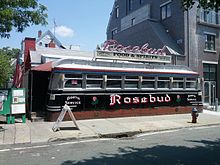
A crude forerunner of the diner was created in 1872 by Walter Scott, who sold nutrient out of a horse-pulled wagon to employees of the Providence Journal, in Providence, Rhode Island. Scott's diner can be considered the kickoff diner with walk-upwards service, as it had windows on each side of the railroad vehicle.[ citation needed ] Commercial production of such "luncheon wagons" began in Worcester, Massachusetts, in 1887, by Thomas Buckley. Buckley was successful and became known for his "White House Cafe" wagons. Charles Palmer received the showtime patent (1893) for the diner, which he billed every bit a "Night-Lunch Wagon." He built his "fancy night cafes" and "night lunch wagons" in the Worcester area until 1901.
Prefabricated diners [edit]
As the number of seats increased, wagons gave way to pre-fabricated buildings fabricated by many of the aforementioned manufacturers which had made the wagons. Similar the luncheon wagon, a stationary diner allowed one to set up up a nutrient service business concern quickly using pre-assembled constructs and equipment.
The Transfer Station neighborhood of Union Urban center, New Bailiwick of jersey was the site, in 1912, of the outset lunch wagon congenital by Jerry and Daniel O'Mahoney and John Hanf, which was bought for $800 and operated by eating house entrepreneur Michael Griffin, who chose the location for its copious human foot traffic. The railroad vehicle helped spark New Jersey'south golden historic period of diner manufacturing, which in plough fabricated the state the diner majuscule of the world. In the decades that followed, nearly all major U.South. diner manufacturers, including Jerry O'Mahoney Inc., started in New Bailiwick of jersey.[four] Jerry O'Mahony (1890–1969), who hailed from Bayonne, New Jersey, is credited past some to have made the offset such "diner".[5] The O'Mahony Diner Company of Elizabeth, New Jersey, produced ii,000 diners from 1917 to 1952. Only approximately twenty[6] remain throughout the United states and abroad. Others more credibly credit Philip H. Duprey and Grenville Stoddard, who established the Worcester Lunch Machine and Railroad vehicle Manufacturing Company in Worcester, Massachusetts, in 1906, when O'Mahony was still just 16.
Until the Cracking Depression, most diner manufacturers and their customers were located in the Northeast. Diner manufacturing suffered with other industries during the Depression, though not as much as many industries, and the diner offered a less expensive way of getting into the restaurant business too as less expensive nutrient than more than formal establishments. After World War Two, as the economy returned to noncombatant product and the suburbs boomed, diners were an attractive small business opportunity. During this period, diners spread beyond their original urban and minor boondocks market place to highway strips in the suburbs, even reaching the Midwest, with manufacturers such as Valentine. Afterward the Interstate Highway System was implemented in the U.S. in the 1960s, diners saw a boom in business every bit mobile travellers would stop for a meal.[vii]

In many areas, diners were superseded in the 1970s past fast nutrient restaurants, but in parts of New Jersey, New York, the New England states, Delaware, and Pennsylvania, the independently owned diner remains relatively common. Since the 1970s, most newly constructed diners lack the original narrow, stainless steel, streamlined appearance, and are usually much bigger buildings, though some are still made of several prefabricated modules, assembled on site, and manufactured past the old line diner builders. A wide variety of architectural styles were now used for these later diners, including Cape Cod and Colonial styles. The old-style single module diners featuring a long counter and a few small booths sometimes now grew additional dining rooms, lavish wallpaper, fountains, crystal chandeliers and Greek bronze. The definition of the term "diner" began to blur as older, prefabricated diners received more conventional frame additions, sometimes leaving the original structure nigh unrecognizable as it was surrounded past new construction or a renovated facade. Businesses that called themselves diners only which were built onsite and non prefabricated began to appear. These larger establishments were sometimes known as diner-restaurants.
Manufacturers [edit]
- Bixler Manufacturing Company
- DeRaffele Manufacturing Co. Inc
- Fodero Dining Motorcar Company
- Jerry O'Mahony Diner Company
- Kullman Dining Car Company
- Mount View Diners Visitor
- Silk City Diners
- Tierney Dining Cars
- Worcester Dejeuner Car Company
- Sterling Streamliner diners

The Salem Diner in Salem, Massachusetts.
Inspired by the streamlined trains, and especially the Burlington Zephyr, Roland Stickney designed a diner in the shape of a streamlined train called the Sterling Streamliner in 1939.[8] Built by the J.B. Judkins jitney company, which had built custom motorcar bodies,[ix] the Sterling and other diner production ceased in 1942 at the beginning of American involvement in World War II. Two Sterling Streamliners remain in operation: the Salem Diner at its original location in Salem, Massachusetts and the Modern Diner in Pawtucket, Rhode Island.
Architecture [edit]
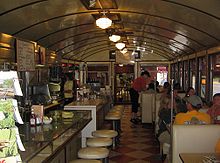
Like a mobile home, the original fashion diner is narrow and elongated and allows roadway or railway transportation to the eatery's site. In the traditional diner floorplan, a service counter dominates the interior, with a preparation area against the back wall and flooring-mounted stools for the customers in front. Larger models may take a row of booths confronting the front wall and at the ends. The decor varied over fourth dimension. Diners of the 1920s–1940s feature Fine art Deco or Streamline Moderne elements or re-create the appearance of runway dining cars (though very few are, in fact, refurbished rails cars). They featured porcelain enamel exteriors, some with the proper name written on the front, others with bands of enamel, others in flutes. Many had a "barrel vault" roofline. Tile floors were common. Diners of the 1950s tended to use stainless steel panels, porcelain enamel, glass blocks, terrazzo floors, Formica, and neon sign trim. Diners congenital in the 2000s generally have a different blazon of architecture; they are laid out more like restaurants, retaining some aspects of traditional diner compages (stainless steel and Fine art Deco elements, commonly) while discarding others (the minor size, and accent on the counter).
Cuisine [edit]
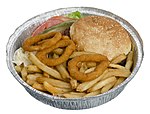
A bacon cheeseburger from a New York City diner in a to-go container, with a pickle slice, onion rings, coleslaw and french fries

Many diners serve a metallic cup alongside a milkshake, containing what cannot fit in the drinking glass.
Many diners serve coincidental food, such as hamburgers, french fries, order sandwiches, and other simple fare. Much of the food is grilled, as early diners were based around a grill. There is often an emphasis on breakfast foods such as eggs (including omelets), waffles, pancakes, and French toast. Menus may somewhat resemble those from greasy spoon-way restaurants. Some diners serve these "breakfast foods" throughout the business concern solar day and others that focus on breakfast may shut in the early on afternoon. These are nearly normally known as pancake houses. Coffee is ubiquitous at diners. Many diners do not serve alcoholic drinks, although some may serve beer and inexpensive vino, while others—specially in New Jersey and on Long Island[ citation needed ]—behave a full drink menu, including mixed drinks. Many diners serve hand-blended milkshakes. The food is usually quite inexpensive.
There is regional variation among diners with traditional food. In the U.S., Michigan and the Ohio Valley at "Coney Isle–way" restaurants, coney dogs are served, as are certain types of Greek cuisine like gyros influenced by Greek diner owners. In Indiana and Iowa, pork tenderloin sandwiches are ofttimes on the menu. The Northeast has more of a focus on seafood[ citation needed ], with fried clams and fried shrimp ordinarily institute in Maine and cheesesteak sandwiches and scrapple in Pennsylvania. Diners in the Southwest U.S. may serve tamales. In the southern U.Southward., typical breakfast dishes include grits, biscuits and gravy, and soul nutrient such as fried chicken and collard greens. In New Jersey, the "Taylor Ham, Egg, and Cheese Sandwich" is a feature of many diners. Many diners have transparent display cases in or behind the counter for the desserts. It is common with new diners to accept the desserts displayed in rotating pie cases. Typical desserts include a variety of pies and cheesecake.
Immigrant influences [edit]
Several international ethnic influences have been introduced into the diner industry in the U.S., considering of generations of immigration.[ten] Many diners in the United States—especially in the Northeast—are owned or operated by outset and 2d generation Americans.[xi] Greek-Americans, Eastern European Americans, besides as Polish, Ukrainian, Eastern European Jews, Italian-Americans, Mexicans and Cubans may accept notable presences. These influences can be seen in certain frequent additions to diner menus, such as Greek moussaka, Slavic blintzes, and Jewish matzah brawl soup, deli-style sandwiches (e.g., corned beef, pastrami, Reubens), and bagels and lox.[12]
Cultural significance [edit]
Diners attract a wide spectrum of the local populations, and are generally small businesses. From the mid-twentieth century onwards, they take been seen every bit quintessentially American, reflecting the perceived cultural diversity and egalitarian nature of the country at large. Throughout much of the 20th century, diners, by and large in the Northeast, were often owned and operated past Greek-American immigrant families. The presence of Greek casual food, like gyros and souvlaki, on several northeastern diners' menus, testifies to this cultural link.[13] [14]
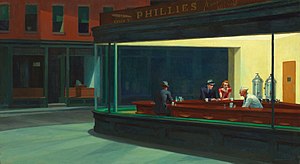
Diners frequently stay open 24 hours a day, especially in cities, and were once the most widespread 24-hour public establishments in the U.S., making them an essential part of urban culture, alongside confined and nightclubs; these ii segments of nighttime urban culture oft find themselves intertwined, as many diners get a practiced bargain of late-dark business organisation from persons departing drinking establishments. Many diners were likewise historically placed near factories which operated 24 hours a twenty-four hour period, with dark shift workers providing a key role of the customer base. For this reason, diners sometimes served every bit symbols of loneliness and isolation. Edward Hopper's iconic 1942 painting Nighthawks depicts a diner and its occupants, belatedly at night. The diner in the painting is based on a real location in Greenwich Village, but was called in function because diners were bearding slices of Americana, meaning that the scene could take been taken from any city in the state-and also because a diner was a place to which isolated individuals, awake long after bedtime, would naturally be drawn. The spread of the diner meant that by 1942 information technology was possible for Hopper to cast this institution in a part for which, xv years earlier, he had used an Automat all-dark restaurant. The diner as an establishment in this painting is a vignette mimicked by a movie lead-in aired nightly on the Turner Classic Movie Channel.
But equally a rule, diners were always symbols of American optimism. Norman Rockwell made his 1958 painting, The Delinquent, generically American by placing his subjects, a immature boy and a protective highway patrolman, at the counter of an anonymous diner.[15] In television and movie house (e.g. The Hulk, Happy Days, Grease and Diner), diners and soda fountains accept come to symbolize the menses of prosperity and optimism in America in the 1950s. They are shown as the place where teenagers see after school and as an essential part of a date. The television set show Alice used a diner equally the setting for the plan, and ane is frequently a regular feature in sitcoms such as Seinfeld. The diner's cultural influence continues today. Many not-prefab restaurants (including franchises like Denny's) have copied the wait of 1950s diners for cornball appeal, while Waffle Business firm uses an interior layout derived from the diner.

Manhattan was once known for its diners. The Moondance Diner was shipped to Wyoming to brand room for development.[sixteen] Diners provide a nationwide, recognizable, fairly compatible place to eat and assemble, desirable traits mirrored by fast food chains. The types of food served are likely to exist consistent, especially inside a region (exceptions being districts with large immigrant populations, in which diners and coffee shops will often cater their menus to those local cuisines), as are the prices charged. At the same time, diners have much more individuality than fast nutrient chains; the structures, menus, and even owners and staff, while having a certain degree of similarity to each other, vary much more widely than the more rigidly standardized chain and franchise restaurants. The Poirier's Diner and Munson Diner, both manufactured by the Kullman Dining Motorcar Company of Lebanese republic, New Jersey, are listed on the National Register of Historic Places.[17]

Diners have figured significantly in American films and television since the grade developed. In I Honey Lucy, the episode titled "The Diner" shows the perils, pitfalls, and difficulty in operating a diner, to much comedic effect. Archetypal appearances include meaning scenes in classic films such equally Sullivan's Travels and The Killers. The 1982 "rites of passage" motion picture Diner was centered on an eatery shared by the protagonists. Waitress in 2007 was nearly a waitress in a diner.[18] Television series include the Food Network evidence Diners, Drive-Ins, and Dives. Pennsylvania Diners and Other Roadside Restaurants, is a 1993 documentary. Diners are the focus of photorealist painter John Baeder who spent about forty years painting diners across the Us. In 1990, Williams Electronics Games introduced a pinball machine entitled Diner. The object of the game is to serve all customers to lite-upwards Dine Fourth dimension (the jackpot).
Meet also [edit]
- Listing of diners, a listing of notable diners in the Us
- Diner lingo, American verbal slang used past staff in diners
- Tiffin counter, a small diner-like eatery located within some other retail institution
- Greasy spoon, any small, cheap eatery including diners
- Cha chaan teng, a diner-like café in Hong Kong
- Dhaba, a roadside diner in Republic of india
- Mamak stall, a diner-similar restaurant in Malaysia
- Warung, cheap eatery in Republic of indonesia
References [edit]
- ^ Restaurants – American Diner (in Finnish)
- ^ "The History of the American Diner". pastemagazine.com. September 5, 2016. Retrieved Nov 30, 2021.
- ^ "The History of the American Diner". pastemagazine.com. September 5, 2016. Retrieved November 30, 2021.
- ^ Gabriele, Michael C. (May 2018). "Bailiwick of jersey Gems". New Jersey Monthly. p. 43.
- ^ p.sixteen Westergaard, Barbara A Guide to New Jersey Rutgers Academy Printing
- ^ "Loading..." www.DinerCity.com . Retrieved October 21, 2017.
- ^ "Diners, the original prefab success story". curbed.com.
- ^ Witzel, Michael Karl (2006). The American Diner. MBI Publishing. pp. 76–78. ISBN978-0-7603-0110-4.
- ^ "1939 Sterling Diner". Antique Car Investments. Retrieved August 7, 2010.
- ^ Maze, Jonathan (March 29, 2017). "For many immigrants, restaurants are the American dream". Nation's Restaurant News . Retrieved December 17, 2020.
Overall, immigrants own 29 percent of all restaurants and hotels, more than twice the 14-percent rate for all businesses, according to U.S. demography data.
- ^ Maze, Jonathan (April 17, 2017). "Why Are Diners Traditionally Greek? It'south an Immigration Story, Naturally". The Kitchn . Retrieved December 17, 2020.
There's no official Agency of Diner Ownership to go along count, simply if y'all're a diner fan, you lot know that Greek families traditionally run the prove at these dear 24-hour joints, particularly in the Northeast.
- ^ Li, Irene (March 11, 2019). "Let's Stop Putting Immigrant-Owned Restaurants Into A Box". WBUR . Retrieved December 17, 2020.
- ^ Berger, Joseph (March sixteen, 2008). "Diners in Changing Hands; Greek Ownership on the Wane". The New York Times . Retrieved May 27, 2009.
- ^ Kleiman, Dena (February 27, 1991). "Greek Diners, Where Anything Is Possible". The New York Times . Retrieved May 27, 2009.
... Greeks became a visible presence in the diner and coffee shop business organisation in the late 1950s after several waves of clearing. They congregated generally in the northeast, where the food service industry provided an easy economic foothold for many immigrants who were frequently unskilled and unable to speak English. Every bit with immigrants from many nations, i relative would send word of opportunity back domicile, encouraging others to come to America.
- ^ Norman Rockwell – The Runaway
- ^ Chocolate-brown, Kristen Five. (August sixteen, 2008). "Moondance diner gathering dust in Wyoming one year subsequently move". Daily News. New York.
- ^ "National Register Information Organization". National Annals of Historic Places. National Park Service. March 13, 2009.
- ^ Jennifer Wright (January xxx, 2015). "How Diner Waitress Uniforms Have Evolved From Scandalous Bloomers to Gingham Dresses". Eater. Retrieved Apr 8, 2016.
Further reading [edit]
- Baeder, John, Diners. Rev. and updated ed. New York: Abrams, 1995.
- Butko, Brian, and Kevin Patrick. Diners of Pennsylvania. Mechanicsburg, PA: Stackpole Books, 1999.
- Garbin, Randy. Diners of New England. Mechanicsburg, PA: Stackpole Books, 2005.
- Gutman, Richard J. Southward. American Diner: And then and Now. New York: HarperPerennial, 1993.
- Witzel, Michael Karl The American Diner. MBI Publishing Company, 1998.
- "Greasin' upwardly the Griddle, and Rollin' into History" The Journal of Antiques and Collectibles, Baronial 2003, retrieved on December 29, 2007.
- Charles Palmer's 1893 patent
External links [edit]
 | Look upwards diner in Wiktionary, the gratis dictionary. |
-
 Media related to Diners at Wikimedia Eatables
0 Response to "Pretty Beach Backgrounds Old Fashioned Diners"
Post a Comment